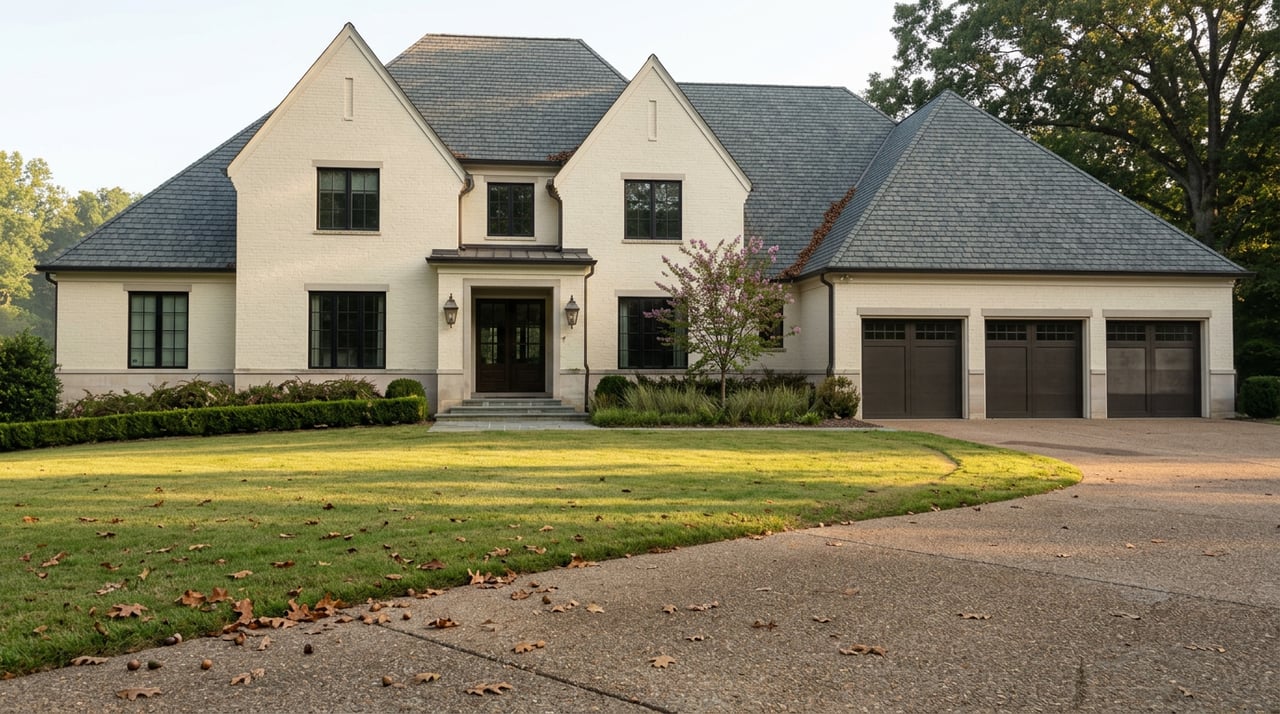
Ask a buyer touring a three-acre lot off Georgetown Pike what makes Great Falls different from McLean or Vienna, and most will say the same thing: more land, same commute. Comparing the areas also means looking at property-specific factors, including utility systems and buildability, alongside the market figures used to describe them.
Great Falls does not price like the rest of Fairfax County, and the reason has less to do with prestige than with plumbing. Because so much of the community sits on low-density estate zoning, the acreage you're buying can come with a private utility system, a set of buildability questions a tax map alone can't answer, and a maintenance calendar most suburban buyers have never had to keep. Reviewing those factors alongside the asking price helps buyers make a more complete comparison.
The Median Is Moving, But Not the Way You'd Think
Two widely used data sets tell almost opposite stories about Great Falls right now, and the gap between them is itself a lesson in how this market behaves.
Over the three months ending May 2026, the median sale price in Great Falls climbed to $1.9 million, up 23.1 percent year over year, even as the average time on market stretched from 30 days to 35. Zillow's broader home-value index, which tracks typical value across the entire housing stock rather than just closed sales, shows the opposite drift: an average value of $1,708,805 as of late May 2026, down 1.2 percent over the same year, with homes going to pending in about 14 days.
Both can be true at once, and that's the point. Great Falls sees a relatively small number of closings each month against a large range of home values, from listings near $750,000 to riverfront estates that regularly exceed $8 million. When one or two large closings land in a given quarter, the median swings hard even though the typical home hasn't moved much. If you're comparing a listing's asking price to "the Great Falls median" you saw on a portal last week, you're comparing it to a number that a handful of transactions can rewrite.
The Zoning Line That Decides What You Can Build
Most of Great Falls sits under Fairfax County's low-density estate zoning, which sets minimum lot sizes. That zoning is the reason the community reads as wooded and spacious rather than subdivided, and it's also the reason a bigger lot doesn't automatically mean a bigger buildable envelope.
A tax-map parcel and a buildable homesite are not the same thing. Fairfax County offers a lot-validation process specifically because older or previously subdivided parcels sometimes can't confirm they qualify for a building permit without that extra step. Before that permit is issued, the lot has to clear a list that includes minimum yard setbacks, floodplain rules, erosion and stormwater requirements, and legal access from a public road. Portions of Great Falls also fall under the county's Chesapeake Bay Preservation Ordinance, which limits clearing near streams and wetland buffers, a real constraint if the acreage you're eyeing backs to one of the community's many tributaries.
A listing description may not cover all of this. A site plan review can help establish the difference between a lot that supports the house you're picturing and one that doesn't.
Private Well and Septic Costs to Consider
Here's the mechanism that actually drives Great Falls economics: because lots are large and public infrastructure is limited, the majority of homes, including multimillion-dollar estates, run on private well and septic rather than county water and sewer. That's not a footnote. It's a parallel cost and inspection system layered on top of the real estate transaction itself.
If public sewer does happen to be available near a given parcel, connection rules and extension costs are part of the due diligence. For most of Great Falls, that math never comes up, because the nearest main is nowhere close, and the property simply needs its own systems.
Before you can rely on those systems, Great Falls Septic Service says the health department requires a site and soil evaluation, commonly called a perc test, to confirm the soil can support a drain field. For an existing home, that means ordering your own inspection and requesting the well completion report and recent water-quality lab results as part of due diligence, not after closing.
The dollar figures are modest compared to the price of the house, but they belong in your budget from the first offer:
| Line item | Typical range | What it tells you |
|---|---|---|
| Septic inspection | $150 to $450 | Confirms system condition before you write an offer |
| Septic pump-out | $300 to $700 | Routine maintenance, not automatically a red flag |
| New well drilling | $3,000 to $15,000 | Varies with depth and local geology |
A Virginia Department of Health septic and well application walks through the certification and permit process for new construction, and state well-location regulations spell out the setback distances that shape where a well can legally sit on a given lot, information worth reviewing before you fall in love with a specific building envelope. Local contractors such as Great Falls Septic Service work within the county's rural-residential rules daily and can speak to what a specific soil type or lot slope means for system design.
Why Some Great Falls Streets Have HOAs and Others Don't
The well-and-septic reality also explains a pattern buyers often find confusing: some Great Falls neighborhoods have homeowners associations and some don't, with little relationship to price. Many of the community's older properties carry no HOA at all, a legacy of large individual parcels developed one at a time. Newer estate communities such as Falcon Ridge, by contrast, typically do have an HOA, not for a clubhouse or pool but to maintain private roads and shared grounds that the county never took over, because those roads were never built to public standard in the first place.
That distinction matters for carrying costs. Neither is better. They're different ways of paying for the same low-density, off-grid infrastructure that defines the area.
Great Falls Crossing is one of the community's most recognized developments for this reason, known for homes that frequently exceed five thousand square feet on expansive, landscaped grounds. The Reserve, Seneca Farms, and Hidden Springs round out the list of established neighborhoods buyers ask about most, each with its own mix of lot sizes and utility setups worth confirming individually rather than assuming from the neighborhood name alone. Land parcels near Lake Potomac, Upper Potomac, and Springvale show up often in current listings, and site-specific questions about stream buffers and septic suitability matter there just as much as anywhere else in 22066.
What This Means If You're Comparing Great Falls to McLean or Vienna
Price per square foot is the wrong first filter here. The better question is whether the parcel you're considering has already cleared, or can clear, the utility and buildability checks that come standard with public water and sewer everywhere else in Fairfax County. Two homes with identical acreage and identical asking prices can carry very different total costs once you factor in well capacity, septic drain field condition, and whether a private road obligation comes attached to the deed.
For a buyer moving up from a townhome or a smaller lot in a more conventional suburb, that's the real adjustment, not the price tag itself, but the due diligence checklist that price tag requires.
Frequently Asked Questions
Do all homes in Great Falls use well and septic? No, but the majority do, especially on the larger parcels that define much of the community. Some estates, particularly on lots close to existing public lines, do connect to county water and sewer. Confirming which system a specific property uses is a first step, not an afterthought.
Can I add a guest house or barn on a well-and-septic lot? It depends on what the existing septic system was designed to support and what the zoning district allows for accessory structures. Both questions require a parcel-specific answer from the county and a soil evaluation, not a general rule of thumb.
Does a bigger lot always mean a stronger investment? Not automatically. A larger lot with septic and buildability constraints can carry more due diligence risk than a smaller lot with a straightforward system already in place. Acreage and value only move together once the utility and zoning questions are answered.
If you're weighing acreage in Great Falls against a move in McLean, Vienna, or elsewhere in Fairfax County, the numbers on a listing sheet only tell part of the story. Rachel Van Zanten works through the zoning, septic, and buildability questions with clients before an offer goes in, not after. Let's Connect.
This article is general information, not legal, tax or financial advice. Consult a qualified professional about your situation.